Views: 0 Author: Site Editor Publish Time: 2026-02-12 Origin: Site


Two band saw blades arrive on the shop floor looking nearly identical. They have the same width, tooth pitch, and packaging style. Yet one blade runs smoothly for weeks while the other fails after only a few shifts. This contrast is a daily frustration for production managers and buyers, and it goes straight to the heart of saw bladelongevity. In reality, long service life is not created by branding or appearance. It is engineered through raw material choices, metallurgical control, and manufacturing discipline. As a professional blade manufacturer, Tangli Tools sees firsthand how rising raw material costs, especially cobalt-bearing steels, are reshaping blade performance expectations and purchasing decisions worldwide.
Saw blade longevity is often misunderstood as simple toughness. In practical terms, it means the blade can deliver stable cutting over more linear meters without sudden performance loss. A long-lasting blade maintains a consistent kerf, predictable cutting speed, and controlled wear pattern from the first cut to the last. Tooth tips wear gradually instead of chipping unpredictably, and the blade tracks straight without excessive vibration.
What longevity does not mean is that a blade can tolerate any cutting condition. Even the best blade will fail if pushed far beyond its design limits. True longevity is about engineered balance rather than indestructibility.
Every blade change interrupts production flow. Machines stop, operators intervene, and downstream schedules are affected. Frequent blade replacement also increases scrap risk during restart and break-in phases. Over time, these interruptions add labor variability and erode throughput.
When blade longevity improves, these hidden costs shrink. Fewer blade changes mean higher machine utilization, more predictable output, and less stress on operators. This is why experienced buyers evaluate blade performance across an entire production cycle rather than judging by purchase price alone.
The cutting edge is where most of the work happens, and its material defines how the blade handles heat and wear. In bi-metal band saw blades, high-speed steel tooth tips such as M42 and M51 are widely used because they retain hardness at elevated temperatures. Cobalt is a key alloying element in these steels. It improves hot hardness, allowing the tooth edge to stay sharp under sustained cutting loads.
As cobalt costs strengthen into 2026, the economics of producing high-quality HSS tooth tips change. Blades with higher cobalt content are more expensive to manufacture, but they often provide superior edge stability when cutting stainless steel, alloy steel, or other heat-generating materials. The cost increase is not arbitrary; it reflects real metallurgical capability.
While tooth tips handle cutting, the backing steel supports the blade through millions of bending cycles. Each rotation around the band wheels introduces stress, and poor-quality backing steel eventually cracks under fatigue. High-grade spring steel backs are engineered to resist this repeated flexing while maintaining sufficient tension for accurate cutting.
A blade with excellent tooth material but weak backing steel will fail prematurely, often breaking far from the cutting zone. This is why raw material quality must be considered across the entire blade structure.
In bi-metal blades, the joint between the HSS tooth strip and the backing steel is critical. Inconsistent joining or uneven heat treatment can create brittle zones or soft edges. Brittle teeth chip easily, while overly soft teeth wear too fast. Precise thermal control during manufacturing ensures uniform hardness and reliable performance.
Tangli Tools invests in controlled heat treatment and joining processes to ensure that raw material potential translates into real-world blade life.
Certain applications generate intense heat and mechanical shock. Cutting stainless steel, high-alloy steel, or bundled materials exposes tooth tips to both thermal stress and intermittent impact. In these conditions, blades with higher cobalt content and optimized metallurgy clearly outperform lower-cost alternatives. The improved hot hardness and toughness slow wear and reduce tooth breakage.
Here, higher raw material cost directly translates into longer service life and fewer unexpected failures.
In high-volume or automated production, blade changes disrupt takt time and introduce variability. Even short interruptions can cascade into missed delivery targets. For these operations, blade longevity is not just a technical parameter but a throughput lever.
Paying more for a blade that runs consistently for longer periods often reduces overall production cost, even if the initial purchase price is higher.
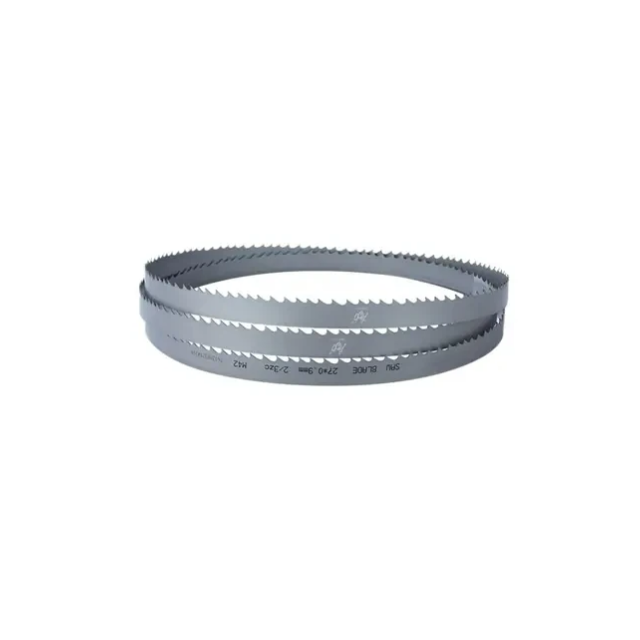
Even premium blades fail if basic setup is wrong. Tooth pitch must match workpiece size and shape. Improper break-in damages the cutting edge before it ever reaches steady operation. Excessive speed or feed generates unnecessary heat and accelerates wear.
In these cases, upgrading blade material alone does not solve the problem. Longevity depends on matching blade design to cutting conditions.
Blade performance is also influenced by machine alignment, guide condition, and coolant delivery. Misaligned wheels increase stress on the backing steel. Poor guides allow vibration that chips teeth. Inadequate coolant raises cutting temperature and accelerates wear.
Buyers should verify these factors before attributing short blade life solely to blade quality.
Coatings applied to bi-metal blades reduce friction and heat generation at the cutting interface. By lowering thermal load, coatings extend the usable performance window of the underlying HSS material. This allows blades to run longer between changes, particularly in continuous cutting operations.
Tangli Tools offers coated band saw blades designed to complement high-quality base materials and deliver more stable cutting performance.
Carbide tipped band saw blades represent a significant step up in raw material investment. Carbide teeth offer exceptional wear resistance and heat tolerance, making them suitable for abrasive or exotic alloys. In the right application, carbide tipped blades can last multiple times longer than bi-metal blades.
However, this performance advantage only materializes when the application justifies it. For simpler materials, carbide may not deliver proportional benefits. Understanding where carbide earns back its cost is essential for smart purchasing.
Blade Type | Tooth Material and Strength | Best-Fit Materials | Longevity Lever | Buyer Cue |
Carbon steel | Basic steel, limited heat resistance | Soft metals, wood | Low cost, simple use | Light-duty cutting |
Bi-metal M42 | Cobalt-bearing HSS, good hot hardness | Mild to medium alloy steel | Balanced wear resistance | General production |
Bi-metal M51 | Higher alloy HSS, stronger edge | Stainless, tougher alloys | Heat resistance | Demanding cuts |
Coated bi-metal | HSS with friction-reducing layer | Continuous cutting | Thermal control | Longer runs |
Carbide tipped | Extreme wear resistance | Abrasive or exotic alloys | Maximum durability | High-value applications |
This overview helps buyers quickly identify which material level aligns with their cutting needs and cost expectations.
Procurement teams often focus on unit price, but blade performance should be framed in terms they recognize. Comparing blade cost against linear meters cut, downtime avoided, and labor stability provides a clearer picture of value. A blade that costs more upfront but lasts significantly longer often delivers a lower cost per cut.
This approach aligns technical performance with financial metrics, making quality easier to justify internally.
Accurate blade selection depends on clear application data. Sharing workpiece material, size, bundle or solid cutting, machine type, target cut rate, coolant usage, and current failure mode allows suppliers to recommend the most suitable blade configuration. This collaboration improves outcomes and reduces trial-and-error costs.
Tangli Tools works closely with customers to translate this information into reliable blade solutions across its Band Saw Blade Series.
Raw material costs are not just numbers on a price list; they are signals of capability when properly matched to application needs. Cobalt-bearing HSS and advanced carbide materials enable longer, more stable cutting performance when used in the right conditions. For manufacturers seeking predictable output, long-lasting saw bladeperformance is engineered through informed material choices rather than marketing claims. As an experienced blade manufacturer and supplier, Tangli Tools supports customers with bi-metal, coated, and carbide tipped band saw blades designed for real production demands. To discuss your cutting materials, machine setup, and blade performance goals, contact us and explore how our Band Saw Blade Series can help optimize your operations.
Q1: Why do two band saw blades with similar appearance have very different lifespans?
Because internal materials, especially tooth metallurgy and backing steel quality, determine heat resistance and fatigue life, which are not visible from the outside.
Q2: Does higher cobalt content always mean better blade life?
Higher cobalt content improves hot hardness, but benefits depend on the cutting application. For low-heat jobs, the advantage may be limited.
Q3: When should carbide tipped blades be considered?
Carbide tipped blades are best for abrasive or exotic materials where extended wear resistance can justify higher raw material cost.
Q4: How can Tangli Tools help improve blade longevity in my application?
By analyzing cutting conditions and recommending suitable blade materials and configurations from its Band Saw Blade Series to balance durability and cost.