Views: 0 Author: Site Editor Publish Time: 2026-08-13 Origin: Site


Machining sticky, non-ferrous materials at high speeds presents a distinct set of challenges. Aluminum alloys like 6061 and 7075 are notorious for causing Built-Up Edge (BUE) and poor chip evacuation during aggressive cutting cycles. These issues consistently ruin surface finishes and force premature tool replacements. Manufacturers require a reliable tribological solution. You want an option bridging the gap between standard polished carbide and ultra-expensive Polycrystalline Diamond (PCD) tooling. Diamond-Like Carbon (DLC) fills this exact void seamlessly. This guide is designed specifically for CNC shop owners, manufacturing engineers, and machinists. We will help you evaluate modern tooling investments properly. You will discover whether the premium price tag for a dlc coated aluminum milling cutter translates to a justifiable reduction in cost-per-part and minimizes costly machine downtime.
Friction Reduction: DLC coatings offer an exceptionally low coefficient of friction (often <0.1), actively preventing chip welding in soft non-ferrous metals.
Extended Tool Life: High surface hardness (up to 80-90 GPa for certain ta-C DLCs) protects the carbide substrate, extending tool life by 3x to 10x compared to uncoated tools.
Surface Finish: Enables near-mirror finishes on aluminum parts, often eliminating the need for secondary polishing operations.
ROI Threshold: Best deployed in high-volume production, lights-out machining, or tight-tolerance aerospace/medical components where tool-change downtime is costly.
Aluminum possesses a relatively low melting point alongside incredibly high ductility. When you machine it at high Material Removal Rates (MRR), the intense pressure and friction generate significant heat at the cutting zone. This environment causes the aluminum to temporarily soften. It then micro-welds itself directly onto the cutting edge of the tool. Industry professionals refer to this phenomenon as Built-Up Edge, or BUE. Once BUE begins, it creates a cascading failure effect.
The cost of BUE severely impacts shop profitability. As material accumulates on the flute, the tool loses its original sharp geometry. The cutter begins tearing the material rather than shearing it cleanly. This tearing action degrades the surface finish immediately. Parts fail quality inspections due to unacceptable roughness averages (Ra). Furthermore, the built-up material alters the effective diameter of the tool. You end up producing out-of-tolerance parts. Eventually, the welded material breaks off. When it snaps away, it frequently takes a microscopic piece of the carbide edge along with it. This causes premature tool failure and halts production entirely.
Traditional tooling solutions struggle to combat this specific issue. Standard tool coatings, such as Titanium Aluminum Nitride (TiAlN) or Aluminum Titanium Nitride (AlTiN), perform exceptionally well in steel. However, they fail miserably in aluminum applications. These standard coatings contain aluminum. Consequently, they possess a strong chemical affinity for aluminum workpieces. Introducing an aluminum-based coating to an aluminum part actually exacerbates the sticking problem. The workpiece material eagerly bonds to the coating. This reality forces machinists to seek alternative surface treatments entirely.
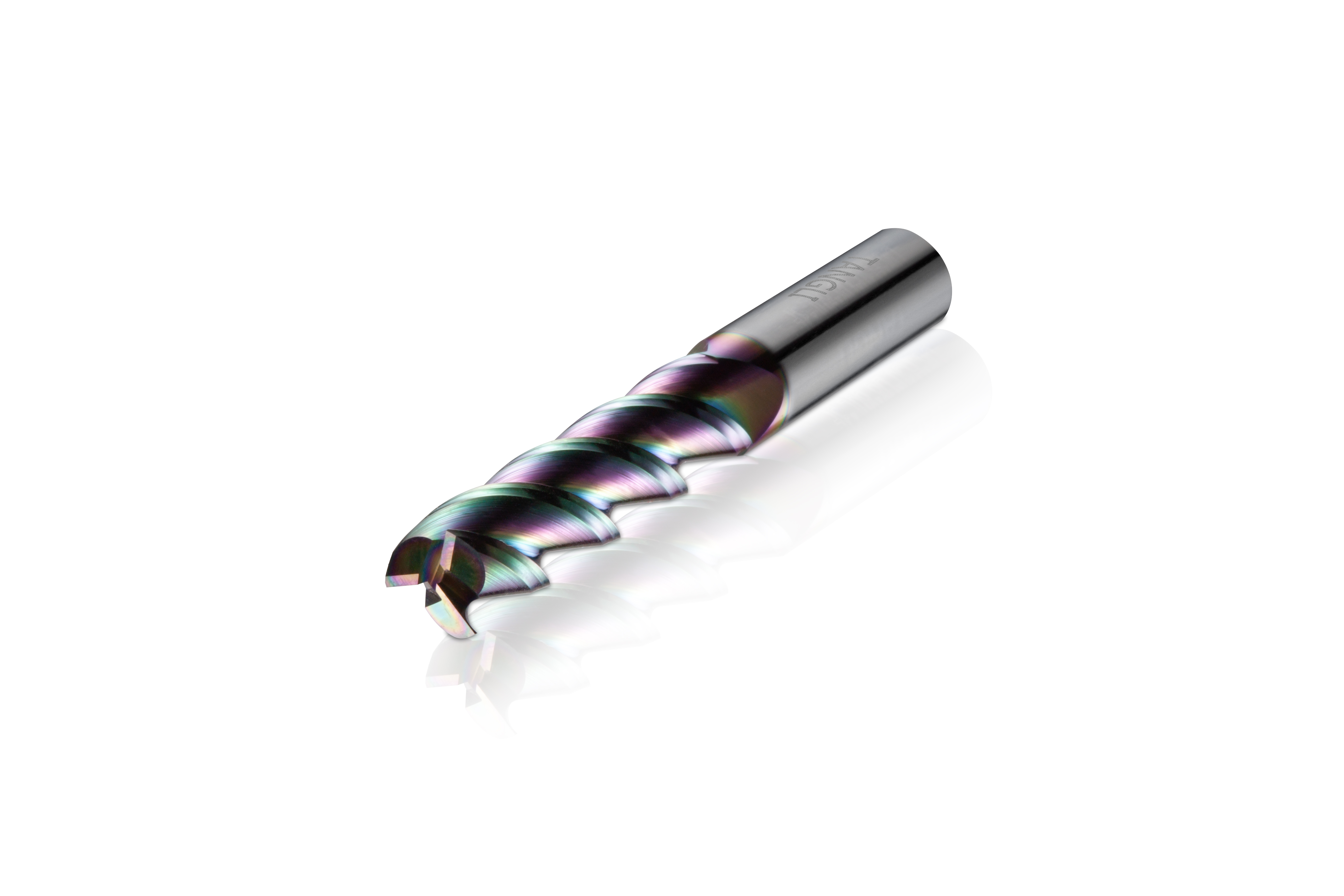
To understand the solution, we must look at the physical properties of Diamond-Like Carbon. DLC is an amorphous carbon material. It uniquely combines two distinct types of atomic bonds. It features sp2 graphite bonds, which provide exceptional lubricity. Simultaneously, it contains sp3 diamond bonds, which deliver extreme hardness. This dual-natured atomic structure makes a diamond-like coating cutter an absolute powerhouse in the machining industry.
The primary tribological advantage of DLC is its function as a permanent dry lubricant. The coating offers a remarkably low coefficient of friction. Typically, it measures below 0.1 against most non-ferrous metals. Because the surface is so slick, aluminum chips simply glide up the flute. They evacuate the cutting zone rapidly without adhering to the tool face. This smooth evacuation drastically reduces overall cutting forces. You will notice a measurable drop in spindle load when switching to this technology. The machine works less intensely to remove the same volume of material.
Thermal management improves dramatically as well. Friction generates heat. By neutralizing friction, DLC minimizes heat generation at the shear zone. A cooler cutting environment keeps both the non-ferrous milling tool and the workpiece dimensionally stable. Aluminum expands rapidly when heated. If the part gets too hot during machining, it will shrink after you remove it from the vise. This thermal expansion causes critical dimensions to drift out of tolerance. DLC prevents this thermal drift. You maintain precise control over your geometries from the first part to the last.
Selecting the right tool involves more than just asking for a specific coating. The underlying foundation matters immensely. A sub-micron grain carbide substrate is absolutely mandatory. DLC forms an ultra-hard, somewhat brittle layer. If the underlying carbide flexes or chips, the coating will fracture immediately. High-quality sub-micron carbide provides the rigid, compressive support necessary to sustain the DLC layer during aggressive cutting.
Tool geometry plays an equally vital role in non-ferrous applications. Flute count requires careful consideration. A 3-flute aluminum mill represents the industry standard for most CNC operations today. Two-flute tools offer massive chip clearance but lack core strength. Four-flute tools are exceptionally strong but restrict chip evacuation in gummy materials. A three-flute design perfectly balances core rigidity with adequate chip pocket volume. Helix angles also demand attention. A helix angle between 35° and 45° efficiently lifts chips up and out of deep pockets.
Coating adhesion and thickness determine the lifespan of a DLC coated end mill. Poor adhesion leads to rapid delamination. The coating essentially peels off the tool. Premium manufacturers utilize specialized edge preparation techniques before deposition. They also keep the coating exceptionally thin, typically ranging from 1 to 3 microns. Thick coatings round off the cutting edge. In aluminum machining, you need a razor-sharp edge to shear the material cleanly. Thin deposition preserves this critical sharpness.
Machinists must also decide between standard end mills and specialized profile tools. Standard square or ball-nose end mills handle basic pocketing and facing beautifully. However, complex extrusions often demand a dedicated aluminum profile cutter. Profile cutters match the exact contours of custom extrusions. They reduce cycle times by cutting complex shapes in a single pass rather than relying on heavy 3D surfacing routines.
Feature | Standard Uncoated Carbide | Typical DLC Coating | Impact on Machining |
|---|---|---|---|
Coefficient of Friction | ~0.4 to 0.5 | <0.1 | Eliminates chip welding |
Surface Hardness | 1,500 - 1,800 HV | 4,000 - 8,000 HV | Resists abrasive wear |
Coating Thickness | N/A | 1 - 3 microns | Maintains razor-sharp cutting edge |
Ideal Application | Prototyping, plastics | High-volume aluminum, brass | Maximizes continuous production limits |
Investing in advanced tooling requires corresponding updates to your machining parameters. You cannot run these cutters using old, conservative feed rates. To realize the true financial benefits of DLC, programmers must push Surface Footage (SFM) and chip loads significantly higher than those used for uncoated carbide. Running them too slowly wastes their immense potential. It also increases the risk of rubbing rather than cutting, which dulls the tool prematurely.
Consider the following implementation rules to maximize your success:
Optimize Speeds and Feeds: Increase your RPMs to hit the maximum SFM recommended by the tool manufacturer. Do not hesitate to push feed rates to maintain a healthy chip load.
Re-evaluate Coolant Strategies: DLC excels in Minimum Quantity Lubrication (MQL) environments. You can often eliminate messy flood coolant completely. The coating acts as its own lubricant. If you perform deep hole pocketing, you may still need air blasts or light coolant to physically clear chips out of the cavity.
Audit Setup Rigidity: Never use premium tools in sloppy setups. Ensure your tool holders possess minimal runout (less than 0.0002 inches). Confirm your workholding clamps the part securely. The ultra-hard carbon coating is highly susceptible to micro-chipping under heavy vibration or chatter.
Respect Material Limitations: Keep these cutters strictly away from ferrous materials. Machining steel, stainless steel, or iron will cause rapid thermal degradation of the carbon layer. High temperatures cause the carbon to diffuse directly into the iron. This chemical reaction strips the coating away in seconds, ruining an expensive tool.
Many shop managers hesitate when they see the purchase order for advanced coatings. A transparent breakdown clarifies the logic. The upfront tool acquisition cost usually sits 30% to 50% higher than an uncoated equivalent. However, you must evaluate the Cost-Per-Part (CPP). The savings stem from massively extended tool life. If a coated tool costs 50% more but lasts 400% longer, the financial decision becomes obvious. You buy fewer tools annually.
You also save money by reducing machine downtime. Every time a machinist stops a cycle to swap a dull end mill, you lose spindle time. In automated or lights-out manufacturing environments, unpredicted tool failure ruins entire production shifts. DLC provides predictability. You know exactly how many hours the cutter will survive.
Review these success criteria before adopting the technology shop-wide:
Are you currently running high-volume production schedules?
Are you consistently failing surface finish inspections using uncoated tools?
Is tool-change downtime actively eating into your profit margins?
Do you machine highly abrasive non-ferrous materials, such as high-silicon cast aluminum?
If you answered yes to these questions, initiate a controlled test. Recommend starting with a limited run of 5 to 10 parts. During this test phase, meticulously document the spindle load on your CNC control. Measure the surface roughness (Ra) of the finished components. Inspect the tool wear under a microscope. Compare these metrics directly against your baseline uncoated performance. Once the data proves the cost-per-part reduction, scale the implementation across the rest of the shop floor.
Advanced tooling investments require objective, data-driven decisions. While not strictly necessary for simple prototypes or low-volume, loose-tolerance work, DLC-coated cutters remain a calculated, essential upgrade for high-efficiency non-ferrous production. They solve the persistent headaches of Built-Up Edge, unpredictable tool life, and rejected surface finishes. They transform challenging aluminum alloys into highly predictable, manageable materials.
Take action by evaluating your current highest-volume aluminum jobs. Identify the bottlenecks caused by poor chip evacuation or rapid tool wear. Encourage your engineering team to consult directly with your tooling provider. They will help you match the specific DLC type—such as hydrogenated amorphous carbon versus tetrahedral amorphous carbon (ta-C)—to your exact material grade. Implementing the correct coating chemistry ensures you maximize your return on investment and keep your spindles turning profitably.
A: No. At high temperatures, the carbon in the DLC coating diffuses directly into iron. This chemical reaction strips the coating rapidly and ruins the tool. It is strictly a non-ferrous milling tool designed for aluminum, brass, copper, and plastics.
A: ZrN is an excellent, cost-effective coating for general aluminum work. However, DLC offers significantly higher hardness and a much lower coefficient of friction. This yields longer tool life in highly abrasive alloys, such as high-silicon cast aluminum.
A: A 3-flute mill offers better balance and higher feed capabilities. A 2-flute provides maximum chip clearance. Modern high-performance 3-flute DLC tools feature engineered flutes that effectively balance clearance and rigidity, making them superior for both slotting and profiling.
A: While the coating allows for aggressive dry or Minimum Quantity Lubrication (MQL) machining, flood coolant is still occasionally recommended. In deep pocketing, you need fluid or strong air blasts to flush chips away and prevent recutting, even though the coating itself prevents chip welding.