Views: 0 Author: Site Editor Publish Time: 2026-08-12 Origin: Site


In high-volume industrial fabrication, tooling costs and machine downtime directly impact profitability. Selecting the right cutting tools requires moving far beyond basic spec sheets. You need a deep understanding of shop-floor realities to optimize production workflows. While carbide-tipped alternatives exist, the high-speed steel cold saw remains a staple for highly specific cold-saw applications. It offers distinct advantages regarding shock resistance, cutting precision, and long-term lifetime value.
This guide provides a comprehensive procurement-level evaluation framework for these cutting tools. We detail exact metallurgical differences across various blade materials to help you make informed decisions. We also explore application matching, surface coatings, and mechanical tolerances. Finally, you will learn how to evaluate long-term financial efficiency when setting up your cutting stations. Understanding these critical variables transforms a basic purchasing decision into a strategic operational advantage for your entire facility.
Total Cost of Ownership: HSS blades offer a lower cost per cut in high-volume applications due to their ability to be resharpened multiple times.
Material Matching: Success relies heavily on matching blade metallurgy (M2 vs. M35) and coatings to the specific tensile strength of the target material.
Operational Tolerance: High-speed steel is inherently tougher and less brittle than carbide, making it the preferred ferrous metal cutter for interrupted cuts or less rigid setups.
Critical Variables: Blade lifespan is dictated not just by quality, but by operator control over feed rates, RPM matching, and coolant application.
Manufacturers constantly balance upfront tooling costs against production speed. You also have to consider secondary finishing requirements. A cheaper disposable blade might cut fast initially. However, it often leaves heavy burrs on the workpiece. You then spend extra money and labor hours deburring parts manually.
Impact resistance remains a crucial differentiator between these two materials. HSS naturally flexes under lateral stress. If a workpiece shifts slightly in the vise, a high-speed steel saw blade absorbs the sudden shock. Conversely, a rigid tungsten carbide tooth chips or shatters upon impact. Shattered carbide ruins the tool instantly and stops production.
Resharpening economics heavily favor high-speed steel. Here is where the value truly compounds over time. You can send an industrial steel blade out for CNC regrinding up to 15 or 20 times. You essentially get 20 life cycles out of one initial purchase. This capability drastically lowers your long-term tooling budget compared to single-use alternatives.
Abrasive wheels melt through metal using high RPM friction. This harsh process alters the metallurgical structure of the workpiece. It hardens the edge and leaves heavy slag behind. Cold cutting operates entirely differently. It shears the metal away at low speeds. You get a burr-free, mill-ready finish without any heat distortion. Lowering the blended cost-per-cut while maintaining precise tolerances in high-production runs defines the ultimate success criteria for modern fabrication shops.
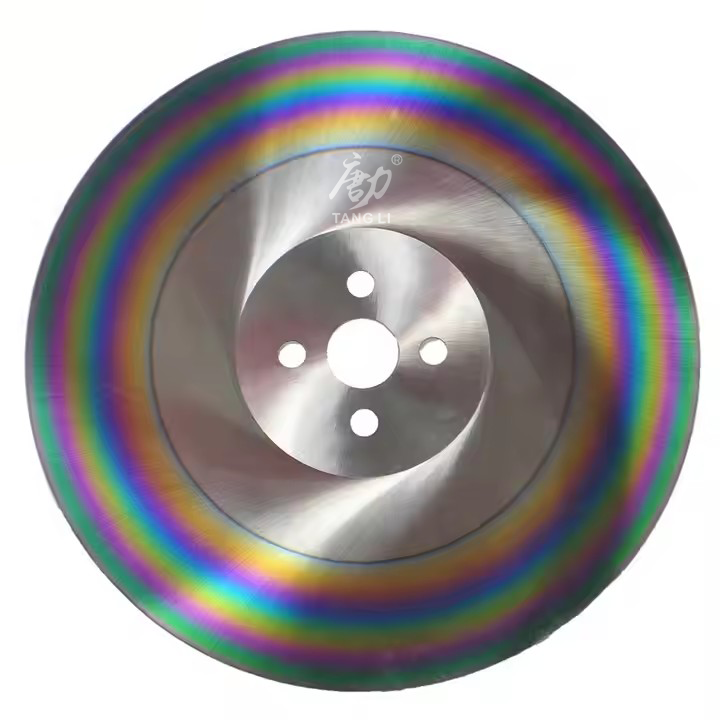
Procurement teams must evaluate specific technical dimensions before placing orders. You cannot treat these tools as generic consumables. Understanding metallurgy and geometry prevents costly operational failures.
DMo5 (M2) acts as the industry standard for general fabrication. It offers incredible toughness and impact resistance. You should specify M2 for standard mild steels and alloys rated up to 800 N/mm².
EMo5Co5 (M35 Cobalt) includes a 5% cobalt infusion. Cobalt provides superior "red hardness," preventing the teeth from softening under extreme thermal loads. You absolutely need M35 when cutting stainless steel or high-tensile alloys.
Grade Specification | Alloy Composition | Primary Advantage | Best Application Target |
|---|---|---|---|
DMo5 (M2) | Standard High-Speed Steel | Maximum shock resistance and toughness | Mild steel, standard structural alloys |
EMo5Co5 (M35) | HSS + 5% Cobalt | Extreme red hardness at high temperatures | Stainless steel, high-tensile alloys |
Bare metal rarely performs optimally in high-friction environments. Coatings drastically improve performance.
Steam Oxide/Vaporized: This represents the standard porous finish. The micropores hold liquid effectively, providing excellent baseline coolant retention during basic cuts.
TiN (Titanium Nitride): A distinctive gold-colored coating. It significantly reduces friction and extends edge life on standard carbon steels.
TiCN / TiAlN: These advanced multilayer coatings are mandatory for high-tensile steels and stainless applications. They enable higher cutting speeds and protect the hardened saw blade from extreme thermal wear.
You must evaluate the "Rule of 3" for every cutting application. This machining rule dictates you must ensure at least three teeth remain engaged in the material at all times. If fewer teeth engage, the pressure per tooth becomes too high. This inevitably causes tooth strippage. Furthermore, matching tooth forms to the material shape is critical. Use High-Low (HZ) forms for solid bar stock. Use an alternate top bevel profile for thin-walled tubing applications to prevent snagging.
Even the highest quality tooling will fail if mismatched with the machine or the material. You must bridge the gap between procurement specifications and shop-floor mechanics.
You cannot just buy any diameter off the shelf. You must align the blade diameter and the specific pinhole configuration exactly with your machine brand. Manufacturers like MEP, Scotchman, and Dake utilize varying drive pin layouts. Using a mismatched pinhole setup causes dangerous slippage.
RPM requirements demand strict adherence. HSS requires highly controlled, low-RPM environments. You generally run these systems between 20 and 90 RPM. The exact optimal speed depends entirely on material diameter and hardness. Running a HSS saw blade too fast generates excessive heat, causing instant failure.
Solid mild steel bar requires aggressive tooth pitch configurations. You also need maximum coolant flow to wash away large, heavy chips from the gullets. Conversely, structural tubing and extrusions require a much finer pitch. You have to manage interrupted cuts carefully. A fine pitch prevents the teeth from grabbing and deforming the thin tube wall during the downward stroke.
Assessing your cooling system directly impacts tooling lifespan. Flood coolant washes away chips effectively and keeps the cut zone cold. However, it creates a messy working environment. Minimum quantity lubrication (MQL) uses precise oil mist instead. MQL creates cleaner parts but requires highly precise nozzle targeting. If operators misalign the MQL nozzle, they will cause rapid HSS degradation.
Understanding how tools fail helps you prevent downtime. Most issues stem from procedural errors rather than manufacturing defects.
Galling, or material welding, happens when hot metal chips weld themselves into the tool gullets. Insufficient coolant application usually causes this phenomenon. Choosing the wrong surface coating also contributes heavily to galling.
Tooth breakage represents a more catastrophic failure. Operators often cause this by pushing aggressive feed rates. Loose clamping setups in the vise also cause severe chatter, leading to shattered teeth. Finally, selecting a pitch too coarse for thin-walled material will instantly snap teeth off the disc.
Training remains a massive blind spot for many industrial facilities. Inexperienced operators often try to rush production quotas. They wrongly assume increasing the RPM on a metal cutting saw will finish the job faster. Speeding up the RPM does not equal faster production; it strictly equals thermal destruction of the cutting edge.
You must plan for maintenance logistics. Factor in the turnaround times for sending dull tools out to a certified CNC sharpening service. Always keep sufficient back-up inventory on hand. You never want a critical cutting station sitting idle while waiting for tools to return from the sharpener.
Partnering with the right tooling supplier determines your long-term success. You should look for engineering support rather than just a transactional vendor.
Ask hard questions before finalizing procurement contracts. Do they offer custom CNC tooth grinding tailored to your facility's main daily application? Do they provide transparent data regarding run-out tolerances and tensioning? Proper tensioning ensures the disc stays rigid and cuts perfectly straight under heavy loads.
Never switch your entire shop over based on a marketing brochure. Run a highly structured test using a premium ferrous metal cutter. Follow this exact protocol to isolate variables:
Document the starting parameters, including machine RPM, downward feed rate, and coolant mixture ratio.
Track the exact number of successful cuts achieved before cut quality degrades.
Measure squareness deviation and burr formation at set intervals during the test run.
Document the exact failure point or the specific reason the operator pulled the tool from the machine.
Begin by auditing your current cutting volume across all shifts. Calculate your baseline cost-per-cut using your existing disposable tooling. Finally, request tailored samples matched explicitly to your most difficult daily cut to prove the concept.
Upgrading to properly specified tooling transforms your cutting station from a frustrating bottleneck into a reliable, predictable process. When you match metallurgy, surface coatings, and tooth geometry to your specific material, you eliminate guesswork. You gain cleaner finishes, reduce secondary deburring labor, and keep your machines running longer.
Your most actionable next step involves reviewing your current vendor relationships. Partner with a manufacturer that provides application engineering support, not just off-the-shelf consumables. By leveraging expert advice on RPM settings and tooth pitch geometry, you maximize the efficiency and profitability of your entire cutting operation.
A: M2 serves as the standard grade, offering excellent toughness ideal for cutting standard mild steels. M35 includes a crucial 5% cobalt addition. This cobalt significantly increases the red hardness and heat resistance of the steel. You must use M35 when cutting harder, heat-generating materials like stainless steel or high-tensile alloys.
A: A high-quality blade typically undergoes resharpening 10 to 20 times during its lifespan. The exact number depends on the blade diameter and the severity of the initial wear. If teeth are severely chipped or broken from operator error, the grinding service must remove more material, reducing total lifecycles.
A: Premature dulling usually results from three common operator errors. The most frequent culprit is setting the machine RPM too high for the material. Selecting an incorrect tooth pitch (TPI) also overworks the edge. Finally, inadequate coolant application causes rapid thermal breakdown of the blade teeth.
A: No. You must never use these blades on standard abrasive chop saws. Abrasive chop saws spin at exceedingly high speeds, often exceeding 3,000 RPM. Cold saw blades are engineered strictly for low speeds, typically under 100 RPM. Using them at high RPMs will cause catastrophic, dangerous failure.