Views: 0 Author: Site Editor Publish Time: 2026-08-10 Origin: Site


High-volume woodworking relies heavily on predictable machine uptime. Tool wear, tear-out, and frequent changeovers directly erode production margins. You need tooling solutions capable of handling aggressive feeds while maintaining crisp edges on engineered panels. Tungsten Carbide Tipped (TCT) tools balance the toughness of steel bodies with the wear resistance of carbide cutting edges. They stand as the undeniable standard for CNC routing and modern panel processing operations. Procurement teams face a constant challenge today. You must source reliable suppliers who deliver consistent quality at scale. This article equips procurement and production managers with an objective evaluation framework. We will explore how to assess supplier capabilities and evaluate essential tool geometry effectively. You will learn the exact steps needed to transition smoothly to a reliable OEM tooling partner without risking costly production downtime.
Cost-per-cut over unit price: Evaluating tool longevity and edge retention yields a more accurate ROI than upfront unit cost.
Application-specific geometry: Selection must align with the material (e.g., MDF, plywood, solid wood) and the specific operation (roughing, finishing, slotting).
Supplier vetting requires strict QC metrics: Reliable OEM partners must provide transparent data on runout tolerances, carbide sourcing, and batch-to-batch consistency.
Testing precedes scaling: Establishing baseline performance metrics through controlled CNC trial runs is mandatory before committing to bulk OEM contracts.
Modern panel processing demands a rigid evaluation of tool performance. You cannot simply default to the cheapest option or the hardest material. Analyzing where a woodworking TCT cutter out-competes High-Speed Steel (HSS) reveals critical operational insights. HSS loses its edge rapidly when cutting abrasive materials. Solid carbide offers exceptional edge retention but suffers from brittleness in large-diameter applications. TCT bridges this gap perfectly. It provides a tough steel body resistant to heavy vibrations alongside brazed carbide tips for superior wear resistance. This makes it a highly cost-effective alternative for bulk material removal.
Reducing tool change frequency directly impacts overall CNC utilization rates. Spindles only generate revenue when they are cutting panels. Every tool change introduces machine downtime. When you extend tool life, you increase your Overall Equipment Effectiveness (OEE). High-quality TCT tooling allows machines to run longer batches before requiring operator intervention.
Material versatility is another crucial factor. Engineered woods pose severe challenges to cutting edges. Melamine, MDF, and particleboard contain highly abrasive resins and glues. These materials degrade lesser alloys prematurely. TCT tools handle these abrasive composites effectively. The carbide tips slice through tough resin layers while the steel core absorbs the intermittent shock loads.
However, we must maintain a balanced perspective regarding application limits. Check these common tooling assumptions:
TCT is not a universal substitute for solid carbide in micro-machining.
It does not excel in ultra-fine finishing requiring intricate fluting.
It excels primarily in standard profiling, sizing, and heavy bulk material removal.
Large-diameter spoilboard surfacing relies heavily on TCT designs for economic viability.
The following performance matrix illustrates where different tooling materials excel across common operational parameters.
Tooling Material | Wear Resistance | Impact Toughness | Cost Efficiency (Large Diameter) | Best Application |
|---|---|---|---|---|
High-Speed Steel (HSS) | Low | High | High | Softwood, low-volume runs |
Tungsten Carbide Tipped (TCT) | High | Medium-High | Highest | MDF, Melamine, Plywood profiling |
Solid Carbide | Highest | Low | Low | Micro-machining, fine finishing |
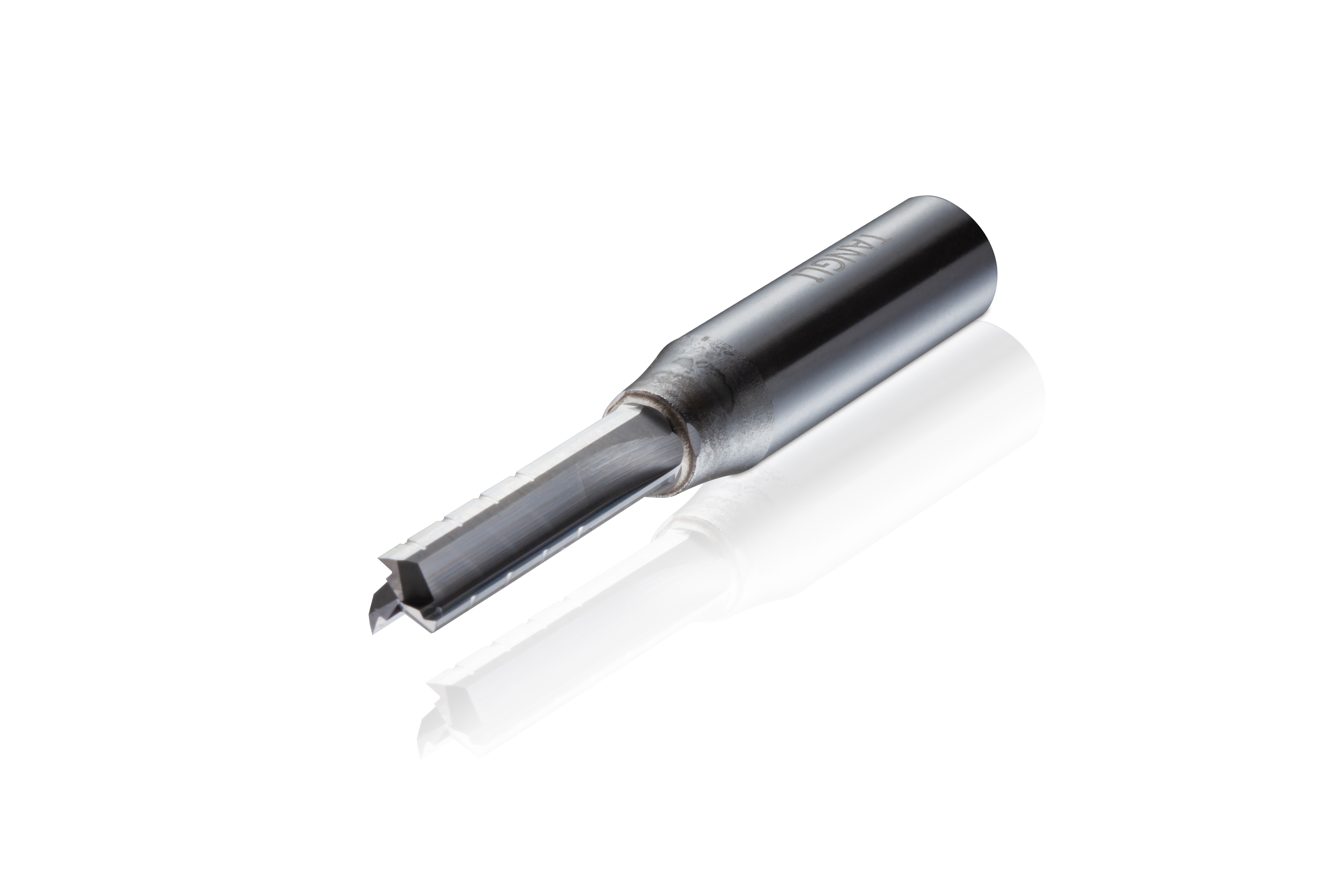
Selecting the right cutting tool requires looking beyond the basic dimensions. You must evaluate the underlying engineering principles guiding its manufacture. These details dictate how well the tool will perform on your shop floor.
The specific grade of carbide dictates edge sharpness and impact resistance. Micro-grain and sub-micron carbide grades offer tightly packed particulate structures. This density allows grinders to achieve a razor-sharp edge. Coarser grades may resist impact better but dull faster on abrasive MDF. You must match the grain size to your specific material. Furthermore, evaluating the brazing process is mandatory. Manufacturers should utilize a silver-copper-silver alloy sandwich for brazing joints. This tri-metal layer acts as a shock absorber. It prevents brittle carbide tips from detaching during aggressive feed rates.
Flute design controls chip flow and cut quality. You will often weigh a TCT straight bit against spiral profiles. Straight flutes work perfectly for standard edge routing on solid woods where chip clearance is straightforward. Conversely, complex shear-angle designs pull chips toward the center of the panel. This compression action leaves clean top and bottom finishes on delicate veneers. Additionally, chip breaker designs play a major role in heavy roughing. Serrated cutting edges grind large chips into fine dust. This reduces cutting resistance, improves evacuation, and significantly lowers the spindle load during aggressive passes.
Precision manufacturing defines tool longevity. Shank tolerance and minimal runout are critical to preventing chatter. Most high-end CNC tools adhere to an h6 shank tolerance standard. When a tool spins out of balance, it introduces severe harmonic vibrations. These vibrations ruin the surface finish and transfer destructive loads directly into the expensive spindle bearings. Ensuring your supplier guarantees low runout extends both tool life and machine longevity.
Off-the-shelf catalog tools rarely optimize high-volume proprietary production lines. Partnering with a dedicated manufacturer allows you to dictate exact geometries. This process demands clear communication and structured workflows.
You begin by translating specific joint designs or proprietary panel profiles into a custom furniture milling tool. Perhaps your assembly line requires a unique tongue-and-groove tolerance. A skilled OEM partner will map these dimensional needs into a specialized tool blueprint.
A rigorous prototyping workflow mitigates production risks. We recommend following these exact steps when commissioning custom tooling:
CAD/CAM drawing approval: Review the digital geometry, verifying clearance angles and cutting diameters.
First-article inspection (FAI): The manufacturer produces a small sample batch for rigorous quality assurance checks.
Sample testing: Run the prototype on your exact CNC machinery under standard feed rates.
Iterative adjustments: Refine rake angles or shear configurations based on actual cut quality and chip load data.
Scalability remains a major hurdle for many suppliers. Moving from a 10-piece prototype run to a 10,000-piece bulk order introduces massive quality control variables. You must assess the manufacturer’s capacity. Do they possess automated CNC grinding centers to maintain tight tolerances across thousands of units? Manual grinding cannot deliver the repeatability required for enterprise-level panel processing.
Finally, consider private labeling options. Effective inventory management relies on clear identification. A capable OEM will provide laser etching services directly on the tool shank. Etching precise specifications, batch numbers, and your company branding simplifies restocking and operator tool selection.
Trust in a tooling supplier must stem from verifiable data rather than marketing claims. You need a partner who demonstrates deep expertise and adheres to recognized industry frameworks.
First, verify the origin of their raw materials. Does the supplier disclose their tungsten carbide sourcing? High-tier manufacturers proudly state their partnerships with global leaders like Ceratizit or Sandvik. They may also utilize verified domestic equivalents. Traceability ensures you receive the metallurgical properties you paid for. Sub-standard carbide leads directly to unpredictable tool failures.
Next, scrutinize their internal inspection protocols. Evidence of dynamic balancing tests is non-negotiable for tools spinning at 18,000 to 24,000 RPM. Tools should meet the G2.5 balancing standard. Furthermore, look for optical profile projection capabilities. Automated grinding equipment, such as Walter or Vollmer CNC grinders, indicates serious capital investment. These machines eliminate human error during the critical sharpening phase.
Certifications offer another layer of trust. ISO 9001 compliance provides a documented quality management system. This framework guarantees that standard operating procedures govern every production step. It ensures batch-to-batch repeatability. When you order a tool six months later, it must perform exactly like the previous batch.
Lastly, evaluate supply chain resilience. A great tool is useless if you cannot get it when needed. Analyze their lead times. Ask about their raw material inventory holding capabilities. Evaluate their response times for emergency tooling replacements. A reliable supplier acts as an extension of your own manufacturing facility.
Transitioning to a new tooling partner requires a systematic, data-driven approach. Do not rely on subjective operator feedback alone. You need hard metrics to justify procurement decisions.
Start by establishing a rigid baseline. Document your current tool life meticulously. Track the linear meters cut before the tool fails or finish quality drops unacceptably. Record the exact spindle RPM and feed rates used during these runs. This baseline becomes the standard against which you measure all new prospective suppliers.
Move into the sampling phase next. Request specific models, such as a carbide milling cutter designed for your most abrasive material. Run this trial tool under identical conditions. Do not alter the feed rate or RPM initially. You must isolate the tool as the only changing variable to gather valid data.
Following the trial, execute a data-driven comparison. Measure the new tool's performance against your documented baseline. Calculate the exact cost-per-meter routed. If Tool A costs 20% more but cuts 50% more linear meters, it is the superior economic choice. Let the mathematics drive your procurement strategy.
Once you validate performance, initiate contract negotiations. Structure your agreements carefully. Discuss Minimum Order Quantities (MOQs) for custom profiles. Establish clear defect replacement policies in writing. Finally, negotiate volume-based tier pricing to secure long-term unit cost reductions as your production scales.
You must move beyond treating cutting tools as generic consumables. View them instead as engineered productivity assets. By rigorously evaluating carbide grades, brazing techniques, and flute geometries, you protect your machine uptime. A well-selected TCT tool reduces operator intervention and maximizes your CNC utilization rates.
We recommend prioritizing manufacturers who demonstrate transparent engineering processes. Look for partners who openly share their raw material provenance and quality control metrics. Establish clear performance baselines, conduct structured trial runs, and let data dictate your final procurement choices. Following this framework ensures you partner with a tooling supplier capable of supporting your long-term manufacturing growth.
A: Lead times generally range from 3 to 6 weeks. The initial CAD approval process takes 3 to 5 days. Producing a prototype for first-article inspection adds another week. Once you approve the sample, bulk production typically requires 2 to 4 weeks, depending on factory capacity and order volume.
A: Yes, TCT router bits can be re-sharpened multiple times. However, each sharpening reduces the tool's overall cutting diameter. This dimensional change requires operators to update tool compensation settings in the CNC software. Many high-end OEMs offer in-house re-sharpening services to restore factory-grade edge geometry.
A: You should request specific chip load charts directly from the manufacturer. Chip load defines the thickness of the material removed by one cutting edge per revolution. You calculate the feed rate by multiplying the target chip load by the number of flutes and the spindle RPM.
A: MOQs vary significantly between suppliers. For initial prototypes, manufacturers often agree to a 2 to 5 piece run. Once you move to standard production, the industry norm for custom-profiled TCT tools typically ranges between 50 and 200 units to offset automated setup costs.